
Frame material uncertainty
Identify the decision to be made, the evidence available and the assumptions that could alter an investment case. The focus is on the uncertainty that matters, not the volume of analysis.
Selected professional experience / Water resource appraisal
A methodology-focused example of how uncertainty, option development, system considerations and whole-life decision support can be brought together for a complex water-resource decision.
The decision class
This page records selected professional experience through a transferable decision framework, not a named organisation, site, asset configuration or project outcome.
Analytical approach
The approach connects forecast uncertainty, solution development, system implications and delivery readiness in one common decision framework. It is designed to make the basis for action explicit and auditable.
Identify the decision to be made, the evidence available and the assumptions that could alter an investment case. The focus is on the uncertainty that matters, not the volume of analysis.
Describe credible pathways at a common system boundary so that technical, operational and delivery implications can be tested together rather than in isolation.
Translate scenario findings into conditions for action: what needs to be true, observed or validated before an investment decision should be released.
Scenario analysis
Scenario analysis tests the inputs that could materially change the decision. It shifts the conversation from one forecast and one preferred answer to the evidence needed for a resilient, adaptable choice.
01 / Uncertainty
02 / Solution families
03 / Decision tests
Transferable insightScenarios make it possible to distinguish a robust decision from one that performs only under a single set of assumptions.
Public boundaryThe framework is illustrative. It does not disclose an organisation, location, asset configuration, capacity, dates, commercial values, option ranking or recommendation.
Decision framework
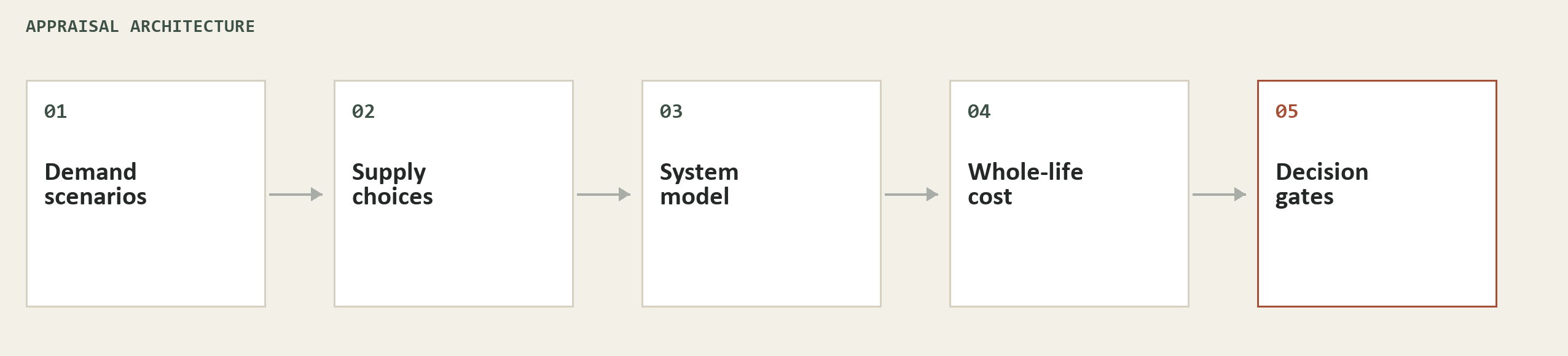
Technical performance, delivery reality and whole-life implications are treated as coupled tests. The framework below conveys the method only: it contains no project figures, relative option values or selected solution.
State the choice, evidence gap and critical uncertainty.
Describe credible solution families at a common system boundary.
Stress-test assumptions across technical, operational and delivery conditions.
Link action to explicit evidence, readiness and governance conditions.
Value lensWhole-life value is considered alongside operational integrity, implementation realism and future flexibility.
Evidence lensInvestment decisions should be released against clear conditions for action, not solely against a forecast or programme date.
Strategic insight
The transferable principle is not a prescribed asset sequence. It is a disciplined way of working: compare pathways consistently, understand the sensitivities and make each commitment only when the relevant evidence has matured.
Set out the evidence, constraints and uncertainty that need to be managed before comparing pathways.
Assess each solution family against the same technical, operational, delivery and whole-life criteria.
Vary the inputs that could change the decision and identify where a pathway loses resilience.
Use clear, proportionate decision gates rather than treating a forecast or programme date as proof.
Experience demonstrated
The professional record demonstrates the ability to move between technical evidence and the decision a project team needs to make, while keeping assumptions, dependencies and evidence requirements visible.
Translate uncertain inputs into a clear view of where a proposed pathway is robust, sensitive or not yet ready for commitment.
Bring engineering, operations, delivery and whole-life considerations into one coherent decision basis.
Define the conditions for action so investment decisions are traceable, proportionate and adaptable as evidence develops.