
Demand scenarios and validation
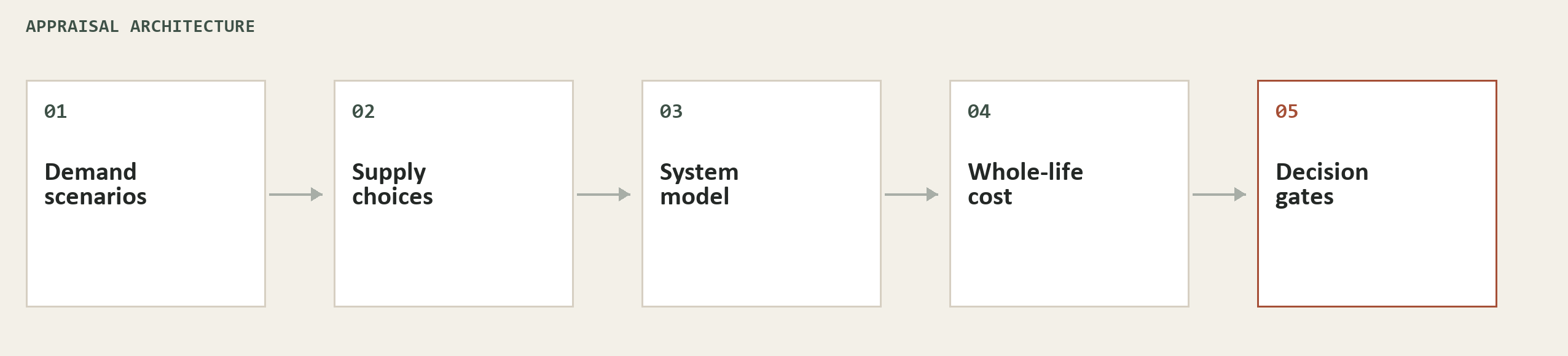
Reconciled development inputs with the central utility forecast, testing timing, persistence, peak demand, water-intensive uses, programme phasing and reuse availability.
Anonymised case study · Water resource strategy
An engineering-led assessment for a large coastal development, bringing demand scenarios, supply configurations, hydraulic interfaces and whole-life economics into a decision-ready investment pathway.
The decision
A fast-growing coastal development needed a strategy for early construction, staged urban and industrial demand, and eventual transition to permanent regional infrastructure. The appraisal turned those connected constraints into a controlled pathway rather than a single, fixed asset choice.
The appraisal
The study combined the questions that materially shaped the preferred route: when demand would arrive, how supply could be configured, what system interfaces were required, and which timing created the most defensible whole-life outcome.
Reconciled development inputs with the central utility forecast, testing timing, persistence, peak demand, water-intensive uses, programme phasing and reuse availability.
Tested four supply configurations across the complete system boundary: source, treatment, intake and discharge, storage, pumping, transmission, temporary supply and operations.
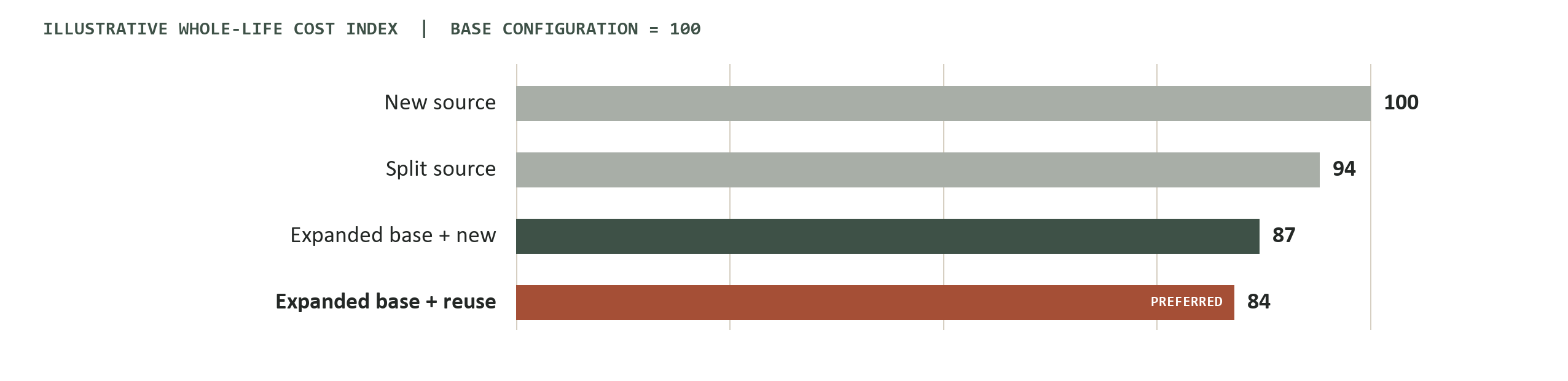
Compared capital, temporary-supply exposure, operating cost and discounted whole-life implications alongside asset readiness, delivery duration, environmental requirements and continuity.
Multi-scenario modelling
The model considered a base demand outlook alongside earlier, later and moderated exceptional-demand cases. Each was tested against alternative supply configurations before a delivery pathway was selected.
01 · Demand cases
02 · Supply paths
03 · Decision tests
What this changedAn option that appeared efficient under one demand curve could be exposed when the timing or magnitude of exceptional demand changed. The model made those decision sensitivities explicit before major capital was committed.
Portfolio noteThis is an anonymised synthesis of the modelling logic. Scenario labels, timings, locations, client data and commercial values have been removed.
Whole-life comparison
Demand start date, peak magnitude, commissioning, temporary-supply duration, transfer readiness and reuse availability were treated as decision sensitivities, not background assumptions.
Recommended delivery pathway
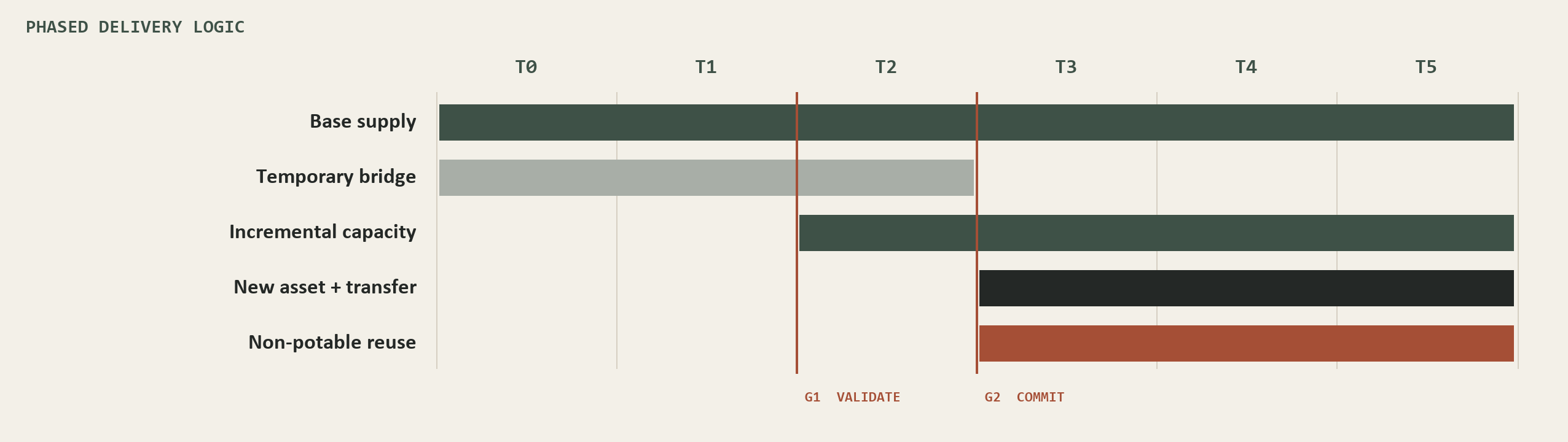
The resulting pathway retained the established source for the near-term base, used temporary supply where needed, set a demand and readiness gate for incremental capacity, and advanced new production and transfer infrastructure only for sustained demand. Non-potable reuse was enabled early as a capacity-management lever.
Decision governance
The recommendation was supported by an assumption register that recorded source, owner, confidence, impact and validation path. This made the dependencies on forecast, approvals, network readiness and construction progress explicit.
Confirm the sustained-demand case, asset and network capacity, and temporary-supply requirements before releasing expansion.
Confirm delivery readiness, environmental approvals, transfer interfaces and construction progress before committing major permanent infrastructure.
Use sensitivity testing and a live evidence register to respond to changing demand, reuse availability and delivery dates without losing the strategic intent.